
September 14, 2026
September 2026 Commentary Blueprint Chesapeake Multi-Asset Trend ETF
Home » Strategies » Exchange Traded Funds » Blueprint Chesapeake Multi-Asset Trend » TFPN Commentary
Portfolio Exposure At A Glance
Notable Holdings By Macro Asset Class
| CURRENCIES | |
|---|---|
| Name | Long/Short |
| Mexico Peso | Long |
| Canadian Dollar | Short |
| Euro | Short |
| China Yuan | Short |
| South African Rand | Long |
| COMMODITIES | |
|---|---|
| Name | Long/Short |
| Silver Future | Long |
| Lean Hogs Future | Short |
| Gas Oil Future | Long |
| Bean Oil Future | Long |
| Rubber Future | Long |
| FIXED INCOME | |
|---|---|
| Name | Long/Short |
| German Bond Future | Short |
| Australian 10-Year Bond Future | Short |
| U.S. 10-Year Treasury Bond Future | Short |
| Japanese 10-Year Bond Future | Short |
| Canadian 10-Year Bond Future | Long |
| EQUITIES | |
|---|---|
| Name | Long/Short |
| General Electric Company | Long |
| Coca-Cola Co | Long |
| Marathon Petroleum Corp | Long |
| Caterpillar Inc | Long |
| McKesson Corp | Long |
ETF holdings and macro asset class allocations are subject to change.
Currencies
Overview
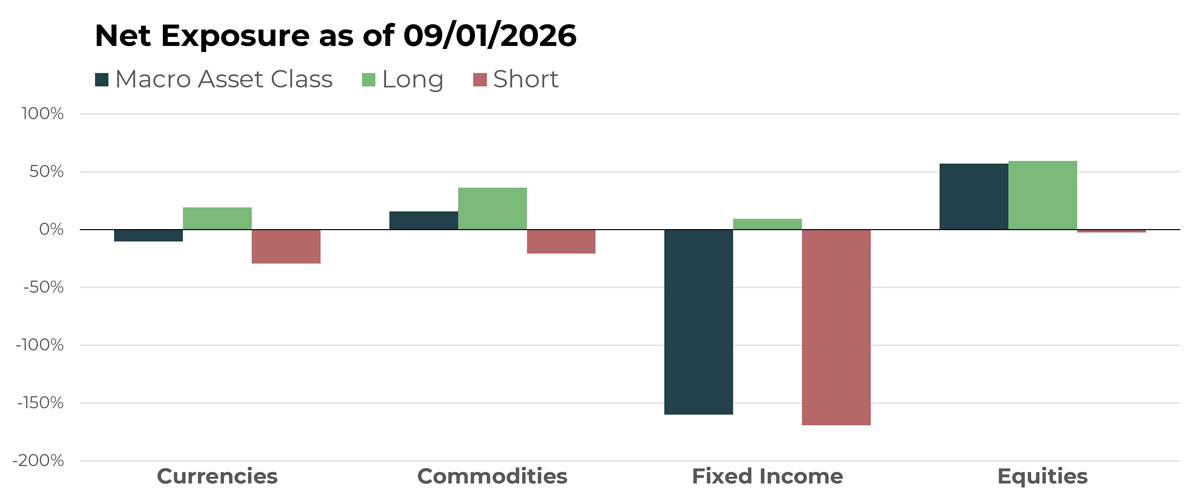
Currency positioning remained net short during August, although the size of that net short exposure declined by approximately 40% heading into September. The change was driven by both a reduction in short exposure and a more modest increase in long positions, leaving the portfolio somewhat more balanced across global currencies.
TFPN’s small long position in Bitcoin futures also continued to expand as the cryptocurrency strengthened. The exposure remains modest relative to the portfolio’s traditional currency positions.
Drivers
Currency markets continued to reflect diverging economic and monetary-policy conditions around the world.
In the U.S., a surprisingly weak July employment report — payrolls declined by 23,000 — added another variable to the interest-rate outlook during August, while persistent inflation continued to complicate expectations for Federal Reserve policy.
One particularly notable development has been the strength of the Chinese Yuan. The currency recently climbed to its highest level against the U.S. Dollar in roughly three and a half years, capping a rally of nearly two years. Chinese policymakers have begun leaning against the move. The central bank has set its daily reference rate on the weak side of market expectations, and Chinese banks have taken steps to temper the advance. Beijing appears to be weighing the benefits of a stronger currency against a domestic economy that is still losing momentum.
Elsewhere, the portfolio maintains long exposure to currencies such as the Australian Dollar, Brazilian Real, Mexican Peso, and South African Rand. Yet, TFPN remains short currencies like the Canadian Dollar, Euro, Japanese Yen, and Swiss Franc.
Commodities
Overview
Commodities experienced the most significant increase in net long exposure of any asset class during August, rising approximately 60% heading into September. The increase was particularly broad-based, with metals, grains, and soft commodities all contributing to the expansion.
Energy exposure declined during the month but remained net long.
Drivers
Metals remain an important component of the commodity portfolio, with the entire segment now positioned long. Aluminum represents the largest individual metals position, accompanied by long positions in gold, silver, copper, platinum, zinc, and iron ore. The breadth of these positions reflects persistent strength across both precious and industrial metals.
Perhaps a more notable recent shift was the change in agriculture. Grains, which had frequently represented a source of short exposure earlier in the year, are now entirely net long. TFPN holds long positions across soybeans, wheat, corn, canola, palm oil, and several other agricultural markets. Soft commodities — including cotton, rubber, sugar, and coffee — also finished August entirely net long. The principal commodity short remaining at month-end was lean hogs, while live cattle remained long.
Energy continued to be heavily influenced by the war involving Iran and disruptions surrounding the Strait of Hormuz. The conflict has affected crude flows and kept an elevated geopolitical risk premium embedded in oil markets. By the end of August, renewed U.S.-Iran military activity again pushed oil prices sharply higher.
The portfolio remains long crude oil and several refined petroleum products, although overall energy exposure was reduced during August. This is a useful example of how TFPN responds to price trends rather than geopolitical forecasts: a major headline may dominate the news without necessarily causing the strategy to increase exposure to that market.
Fixed Income
Overview
Fixed income remained TFPN’s largest overall directional exposure heading into September and continues to be positioned substantially net short. However, the magnitude of that short position declined approximately 15% during August, as the portfolio significantly reduced short exposure to intermediate- and longer-term government bonds.
Short-term interest-rate markets moved in the opposite direction, with net short exposure increasing approximately 15%. As a result, the portfolio remains positioned for interest rates to stay higher than markets had previously anticipated, particularly at the shorter-end of global yield curves.
Drivers
August presented conflicting signals about the direction of interest rates. The July employment report showed an unexpected decline in payrolls, suggesting some softening in the labor market. At the same time, inflation remained stubbornly above the Federal Reserve’s target. By late August, hotter inflation readings and comments from Fed officials had again raised the possibility of tighter monetary policy, contributing to upward pressure on Treasury yields.
TFPN’s largest fixed-income exposure is now concentrated in short-term interest-rate futures. These instruments — including Fed Funds, SOFR, Euribor, SONIA, and similar contracts — can sound more complicated than they are. Rather than representing investments in individual bonds, they allow the portfolio to participate in changing market expectations for short-term interest rates in the U.S., Europe, Canada, Australia, and the United Kingdom.
The portfolio also remains predominantly short longer-term government bonds across several countries, including the U.S., Australia, Germany, Italy, Japan, and the United Kingdom. The primary exception is a long position in Canadian government bonds.
Equities
Overview
Equities remained TFPN’s largest net long asset class heading into September, although net long exposure declined approximately 10% during August. The portfolio remains overwhelmingly tilted toward long individual stocks while adding a modest amount of short exposure through international equity index futures.
Drivers
Artificial intelligence continued to dominate the equity-market narrative during August. Late in the month, NVIDIA reported another strong quarter and issued a revenue outlook that reinforced expectations for continued growth in AI infrastructure spending. The results helped propel technology shares higher and supported a broader U.S. equity market that remained near record levels as August ended.
TFPN’s equity positioning reflects some of those trends without being concentrated exclusively in traditional technology companies. NVIDIA remains a meaningful holding, but the portfolio also holds companies that may benefit from increased investment in infrastructure and industrial capacity, including Caterpillar, GE Vernova, General Electric, Johnson Controls, and Quanta Services.
The long portfolio continues to have broad exposure beyond AI-related companies. Other meaningful positions include Coca-Cola, Marathon Petroleum, McKesson, Bank of America, Newmont, and Deere & Co, among others.
Meanwhile, TFPN entered September with short positions in the Hang Seng Index, Hang Seng China Enterprises Index and South Africa’s JSE Top 40 Index, providing some offset to its substantial long exposure in individual stocks.
Portfolio Managers’ Note
TFPN gained 0.73% (price return) in August. While the monthly gain was modest, the changes occurring beneath the surface of the portfolio were considerably more significant.
August provided another good illustration of why trend following is fundamentally different from trying to predict the next market headline. Investors spent the month evaluating a surprisingly weak U.S. employment report, stubborn inflation, changing expectations for Federal Reserve policy, continued enthusiasm surrounding artificial intelligence, and an ongoing war involving Iran that continued to affect global energy markets. Any one of these developments could provide a compelling argument for where markets “should” go next.
TFPN does not need to make that determination.
Instead, the portfolio continued to respond to the trends emerging from those events. Commodity exposure increased substantially, with particularly broad long positioning developing across metals and agriculture. Equity exposure remained meaningfully net long as U.S. markets traded near record highs, although the portfolio reduced that exposure somewhat during the month. Fixed income remained substantially net short, but the composition shifted away from longer-duration bond shorts to short positioning in global short-term interest rates.
That last distinction is particularly instructive. The strategy did not simply maintain a blanket view that “bonds will fall.” It responded differently to trends across various maturities and countries. The same was true within commodities: energy exposure declined even as geopolitical headlines remained intense, but trends elsewhere led to substantially greater exposure, such as in metals and agriculture.
TFPN’s investment process remains exactly the same. Trend following inevitably experiences periods when established trends retrace or markets change direction. Our objective is not to avoid every losing month or predict every turning point. It is to remain systematic and disciplined, allowing the portfolio to adapt as new trends emerge across equities, fixed income, commodities, and currencies.
That adaptability remains at the core of TFPN’s approach.
The performance data quoted represents past performance. Past performance does not guarantee future results. The investment return and principal value of an investment will fluctuate so that an investor’s shares, when sold or redeemed, may be worth more or less than their original cost and current performance may be lower or higher than the performance quoted.
For standardized performance please visit tfpnetf.com.
Let's Talk
If you’d like to learn more about TFPN, a next-generation liquid alternative