
October 15, 2026
October 2026 Commentary Blueprint Chesapeake Multi-Asset Trend ETF
Home » Strategies » Exchange Traded Funds » Blueprint Chesapeake Multi-Asset Trend » TFPN Commentary
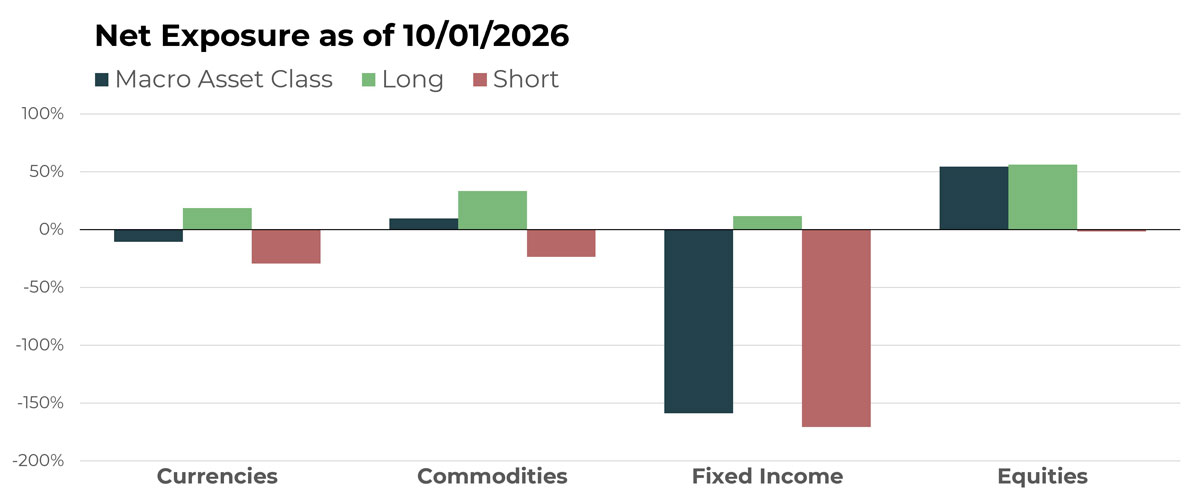
Portfolio Exposure At A Glance
Notable Holdings By Macro Asset Class
| CURRENCIES | |
|---|---|
| Name | Long/Short |
| Brazilian Real | Long |
| Euro | Short |
| Japanese Yen | Short |
| Chinese Yuan | Long |
| Australian Dollar | Long |
| COMMODITIES | |
|---|---|
| Name | Long/Short |
| Crude Oil Future | Long |
| Lean Hogs Future | Short |
| Zinc Future | Long |
| Wheat Future | Long |
| Copper Future | Long |
| FIXED INCOME | |
|---|---|
| Name | Long/Short |
| German Bond Future | Short |
| Australian 10-Year Bond Future | Short |
| U.S. 10-Year Treasury Bond Future | Short |
| Japanese 10-Year Bond Future | Short |
| Canadian 10-Year Bond Future | Short |
| EQUITIES | |
|---|---|
| Name | Long/Short |
| Automatic Data Processing Inc | Short |
| NVIDIA Corp | Long |
| Marathon Petroleum Corp | Long |
| T-Mobile Us Inc | Short |
| McDonald's Corp | Short |
ETF holdings and macro asset class allocations are subject to change.
Currencies
Overview
Currency positioning remained net long international currencies relative to the U.S. Dollar during September, with overall net long exposure increasing by approximately 8% heading into October. The Asia Pacific region continues to represent the bulk of the long book.
TFPN’s small long position in Bitcoin futures also continued to expand as the cryptocurrency strengthened. The exposure remains modest relative to the portfolio’s traditional currency positions.
Drivers
Currency positioning continued to reflect divergent trends across global economies and monetary-policy regimes. TFPN remained long several currencies relative to the U.S. Dollar, including the Australian Dollar, Brazilian Real, British Pound, Mexican Peso, South African Rand, and Korean Won. On the flip side, the portfolio maintained short exposure to currencies like the Canadian Dollar, Euro, Japanese Yen. and Swiss Franc.
The Chinese Yuan remained one of TFPN’s more significant long currency positions. This positioning was consistent with the Yuan’s continued strength during September, when the currency reached multi-year highs against the U.S. Dollar as Chinese policymakers became increasingly tolerant of its appreciation.
As with TFPN’s traditional currency positions, allocations to Bitcoin are driven by persistent price trends rather than forecasts about central-bank policy, economic growth, or the future direction of the U.S. Dollar.
Commodities
Overview
Commodities remained one of TFPN’s largest net long allocations heading into October. Net long exposure declined modestly — approximately 3% during September — but remained broadly diversified across energy, metals, grains, livestock, and soft commodities.
Perhaps most notable is the breadth of the positioning: metals, grains, energy, and soft commodities all remained entirely net long at month-end. Lean hogs represented the primary commodity short position.
Drivers
Commodity markets continued to be influenced by the ongoing conflict with Iran, elevated energy prices, and concerns about global supply chains. Oil prices accelerated late in September as hopes for progress in U.S.-Iran negotiations faded. At the same time, extraordinarily high energy costs contributed to renewed inflation concerns and helped push global bond yields higher.
TFPN remained long crude oil and several refined petroleum products, with overall energy exposure increasing approximately 10% during September.
Metals remained the portfolio’s largest commodity allocation, although exposure declined modestly. The portfolio continued to hold long positions in aluminum, copper, gold, silver, platinum, zinc, and iron ore. Precious metals encountered significant pressure late in September, as sharply higher Treasury yields increased the relative attractiveness of interest-bearing assets. Meanwhile, gold finished September down approximately 6.6%.
Agriculture remained another significant source of long exposure. TFPN entered October long soybeans, corn, wheat, canola, palm oil, bean meal, bean oil, and other grain markets, as well as cotton, rubber, sugar, coffee, and cocoa. This is a meaningful change from earlier in the year, when agricultural markets frequently represented a source of short exposure.
Fixed Income
Overview
Fixed income remained by far TFPN’s largest directional exposure heading into October, with the portfolio maintaining a substantial net short position. Overall net short exposure increased slightly — approximately 0.6% during September — but there was a more meaningful change beneath the surface.
Short exposure to intermediate- and longer-term government bonds increased approximately 8%, while short exposure to instruments tied to short-term interest rates declined approximately 2%.
Drivers
September’s bond market provided one of the clearest examples this year of a sustained trend. The Federal Reserve’s first rate increase in more than three years reinforced expectations that interest rates could remain elevated, while persistent inflation and higher energy prices pushed longer-term borrowing costs sharply higher. By late September, the 10-year Treasury yield had climbed above 5.2% to its highest level since 2007, while the 30-year yield also prepared to reach levels not seen since 2002.
Those moves were not limited to the United States. Global government bonds experienced an exceptionally difficult third quarter, as investors confronted higher inflation, fiscal concerns, and increasingly hawkish central banks. The U.S. 10-year yield rose approximately 81 basis points during the quarter, while Japan’s 10-year yield experienced its largest quarterly increase in more than two decades.
TFPN’s positioning reflects that environment. The portfolio was short government bond futures in the U.S., Australia, Canada, Germany, Italy, Japan, and the United Kingdom at month-end.
The portfolio also maintained substantial short positions in Fed Funds, SOFR, Euribor, SONIA, CORRA, and Australian Bank Bill futures. These instruments are essentially a way to express a view on where short-term interest rates are headed. Rather than purchasing or shorting a traditional bond, these contracts rise or fall as market expectations for future central-bank and money-market rates change. TFPN’s net short positioning generally benefits when expected short-term rates rise.
Equities
Overview
Equities remained meaningfully net long heading into October, although net exposure declined approximately 15% during September. Long stock exposure fell while short exposure increased materially, creating a noticeably more balanced equity allocation than in August.
One notable development was the addition of several short positions alongside the portfolio’s existing short equity-index futures.
Drivers
Equity markets demonstrated considerable resilience during September despite dramatically higher bond yields. Artificial intelligence remained an important source of market enthusiasm, helping support major equity indexes even as higher interest rates increased the cost of capital and placed pressure on portions of the technology sector.
That resilience was not uniform. AI-related semiconductor shares experienced sharp volatility during the month, including a significant mid-September selloff in NVIDIA and other chipmakers. Higher borrowing costs also increasingly became a concern for companies making enormous investments in AI infrastructure.
TFPN nevertheless remained substantially net long equities at month end. Long positions included NVIDIA, Apple, ASML, Caterpillar, GE Vernova, General Electric, Quanta Services, Coca-Cola, Marathon Petroleum, McKesson, Newmont, and Deere, among others. The breadth of these holdings illustrates that the portfolio’s positive equity exposure extends beyond the largest technology companies into industrials, energy, materials, healthcare, and consumer companies.
At the same time, the portfolio expanded its short exposure. TFPN entered October with individual short positions in companies including McDonald’s, T-Mobile, NextEra Energy, TJX, and HCA Healthcare, along with short futures positions in the Hang Seng, Hang Seng China Enterprises, and South African JSE Top 40 indexes.
The result is an equity portfolio that remained clearly net long but has become more selective as trends diverge across individual companies and markets.
Portfolio Managers’ Note
TFPN’s monthly result was relatively contained in September, but the month itself was anything but quiet beneath the surface of global markets.
The Federal Reserve raised interest rates for the first time in more than three years. U.S. Treasury yields climbed to levels not seen since before the Global Financial Crisis. Energy prices remained elevated amid the ongoing conflict with Iran. Artificial intelligence continued to support portions of the equity market despite growing concerns about the cost of financing the enormous infrastructure investment behind the buildout.
For a trend-following strategy, the most interesting part of September may have been the contrast between bonds and stocks:
- Fixed income trends became increasingly pronounced. TFPN remained substantially net short bonds, and short exposure to intermediate- and longer-term government bonds increased as yields continued their multi-month advance.
- Equities, meanwhile, remained surprisingly resilient despite those same higher yields. TFPN therefore stayed net long stocks, but reduced that exposure and introduced additional individual-company shorts as market leadership became less uniform.
- Commodities tell a similar story. The portfolio remained broadly long, but it did not simply increase energy exposure because geopolitical risk dominated the headlines. Instead, exposure continued to reflect trends across a broad collection of markets, including metals, grains, soft commodities, and livestock.
This distinction is important. Trend following does not require every position to tell the same economic story. The portfolio can simultaneously be short bonds, long stocks, long commodities, and short selected currencies because each market is evaluated according to its own price behavior.
Heading into the fourth quarter, TFPN remains positioned for:
- Continued weakness in global fixed income
- Broadly positive trends across commodities
- A positive environment in select areas of equities
As always, those positions are not forecasts. They reflect the trends currently observable across global markets.
.
Let's Talk
If you’d like to learn more about TFPN, a next-generation liquid alternative